Category: Writers

  • To Return

    I.

    I’m sitting on the shores of Lake Washington, amazed at what I can do. I recently finished a solid draft of my second novel. Today I danced hard, biked to the beach, swam in the green-blue waves, and will later have to bike back up all those hills to home. But I can do it. My body and—miraculously—my mind are in the best shape of my life.

    Not bad for someone who’s come back from the dead.

    Coming back isn’t an accurate way to put it though. I died two years ago when I was diagnosed with an aggressive ovarian cancer. I was burnt down, ash of myself sifted through the hands of my doctors and nurses and those who cared about me. Now a new self is writing this—someone I don’t quite recognize, but who I love and want to get to know.

    II.

    I was diagnosed with clear cell carcinoma in May 2021, a few days after my second COVID-19 vaccination shot. After my surgery the next week, removing (along with all of my reproductive organs) a 14-centimeter tumor from my body, I spent a lot of time watching movies and trying to read as I convalesced. I noticed something I never noticed so much before—cancer is everywhere in books and movies. Sometimes it’s a main event, like in Big Fish, and other times it plays a cameo role or hovers in the shadows. But it is almost always there.

    I think fiction takes on cancer because it’s a nearly universal experience—everyone has either experienced it first-hand or knows someone who has experienced it. Giving a character cancer can make them change (or die), move or twist a plot. It can work as a believable deus ex machina in reverse, since anyone at all can suddenly have cancer, no matter how healthy, rich, or smart a person is. A very healthy person can get it (like myself) and it’s a toss-up whether they will get better (like myself) or die of it.

    Cancer is nearly universal—but when it happens to you, the journey you go on is yours alone. And it seems totally unbelievable—a case in which life is stranger than fiction.

    III.

    In my journals of that time, I described cancer as a failure of the body. But I don’t think it is. It seems more like an overexcitement of existence, so many cells dividing that they threaten the organs we need to live. Cancer is part of being a multi-cellular organism—it’s the risk of being alive. Perhaps the disease could be considered a type of creativity. The body births a strange beauty of extra cells, which collect into sculpture-like tumors. It creates its own blood supply to feed its dangerous art form. There is some kind of care taken to tend to the tumors, to assure their longevity and growth—while the rest of the body, the body that wants to live, wages war.
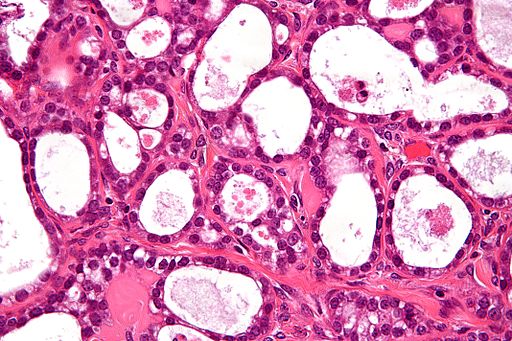
    Nephron, CC BY-SA 3.0 https://creativecommons.org/licenses/by-sa/3.0, via Wikimedia Commons

    Looking at images of clear cell ovarian cancer cells, I can appreciate their strangeness—even their beauty. Stained, they can look like marbleized paper, or abstract painting, or globs of dripped paint. Sometimes, they look like knitting, a shawl made not for wearing, for it won’t keep out the cold, but for its design alone—for the many open spaces.

    IV.

    Surgery first emptied me out, then chemo gutted and hollowed what was left. At my most empty, I had no idea if I’d return from this. And if I returned physically, would my mind?

    On a trip to Whidbey Island with my partner at the time, we met a friend of his I’d never met before—an acupuncturist who took one look at me and said, “That woman you were—she’s not here anymore.”

    V.

    I’m in a bikini on the beach, waves lapping my toes. The new moon stamps the sky. A thick scar begins at the delta of my stomach and curves around my belly button all the way down—a kind of seam where the dangerous sculpture was extracted. Where I was sewn back together, made into another art. It’s a single line painting by Miró. It contains a story, marks the point of no return. It’s the pain of a cracked egg and the beauty of birth. It’s what’s left of the woman I was, and from where I birthed a new self.
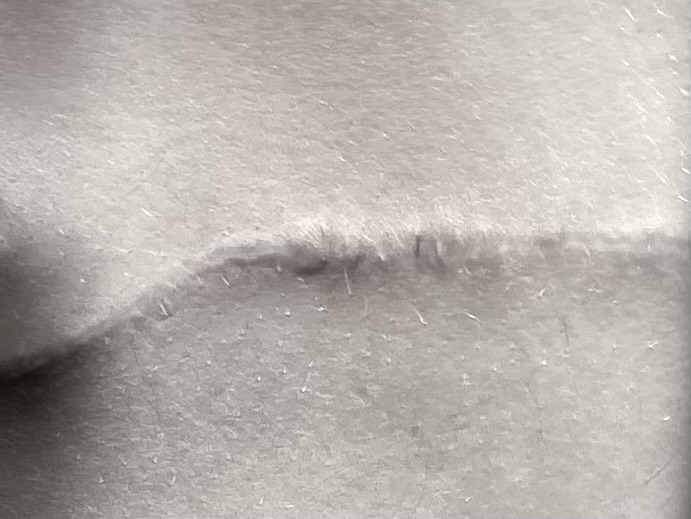
    My hysterectomy scar and Miró’s Painting on white background for the cell of a recluse (I), 20 May 1968, Fundació Joan Miró, Barcelona

    I’m no longer self-conscious of this scar, or feel it’s worth hiding from others. It’s etched on me the way Mt. Rainier is etched in the sky today, every glacier visible and clear.

    VI.

    The toxic medicines used to stop my over-exuberant cancer cells also seemed to stop the creativity in me for a time. It was the emptiest time. At least, that’s how I remember it.

    My friend and writing partner, Suzanne, came to see me every third week—which was my best week—after chemo. She came bearing sunlight, fattening snacks, her laptop and notebooks. We’d make a picnic and sit together out in my courtyard or at my dining room table, be in each other’s silence and presence, and write.

    The process of writing is blank in my mind. I know I worked on a story about the Soviet invasion of Prague, a moment that changed all of my characters’ lives irrevocably and forever. The tanks rolled in like rampant cancer cells, and nothing would ever be the same again.

    I felt like I was mimicking myself—the self I remembered from before. Before, I wrote. I was a writer. But who was I now? I was just typing, trying on a writer’s coat in the presence of another writer. I clacked on the keyboard, stringing letters into words, and words into sentences. So this is what a writer does, I thought. Clack, clack, clack. Clack.

    VII.

    I didn’t know, but I was stringing together a path to return. Like dropping stones to find your way out of a deep, dark wood.

    VIII.

    Later, after the big bad chemo was over and I was on my year of chemo-lite, I opened the file of my novel-in-progress to see if it would have any meaning for me now. My brain was still repairing from the damage the chemo caused and together with massive anxiety, I could only focus for a few minutes at a time, so it took me a while to get back into the material. When I did, I was surprised to find passages I didn’t recognize. I had, apparently, also worked on the novel in my sessions with Suzanne.

    I rediscovered that much of the book centers on the concept of identity, as the characters are guinea pigs for a Witness Protection Program so nascent it has no name yet. I found a note in the margins I’d written a few years ago: “If you get to live, but don’t get to be who you are—is being alive worth it?”

    IX.

    It was like I was writing to my future self, whoever that would be—like I had known what was going to happen to me. Somehow, I knew I would need this—that note, this novel about identity—to help me find a way to a self.

    While my characters were grappling with their multiple iterations of selfhood, I found my answer to that marginal question—a resounding fuck yes.

    X.

    Returning, I realized, isn’t about going back.

    It’s about picking up stones, one at a time, marveling at their shapes, their heft, their colors—their aliveness.


  • Notes and scraps: building a piece of writing

    Notes and scraps: building a piece of writing

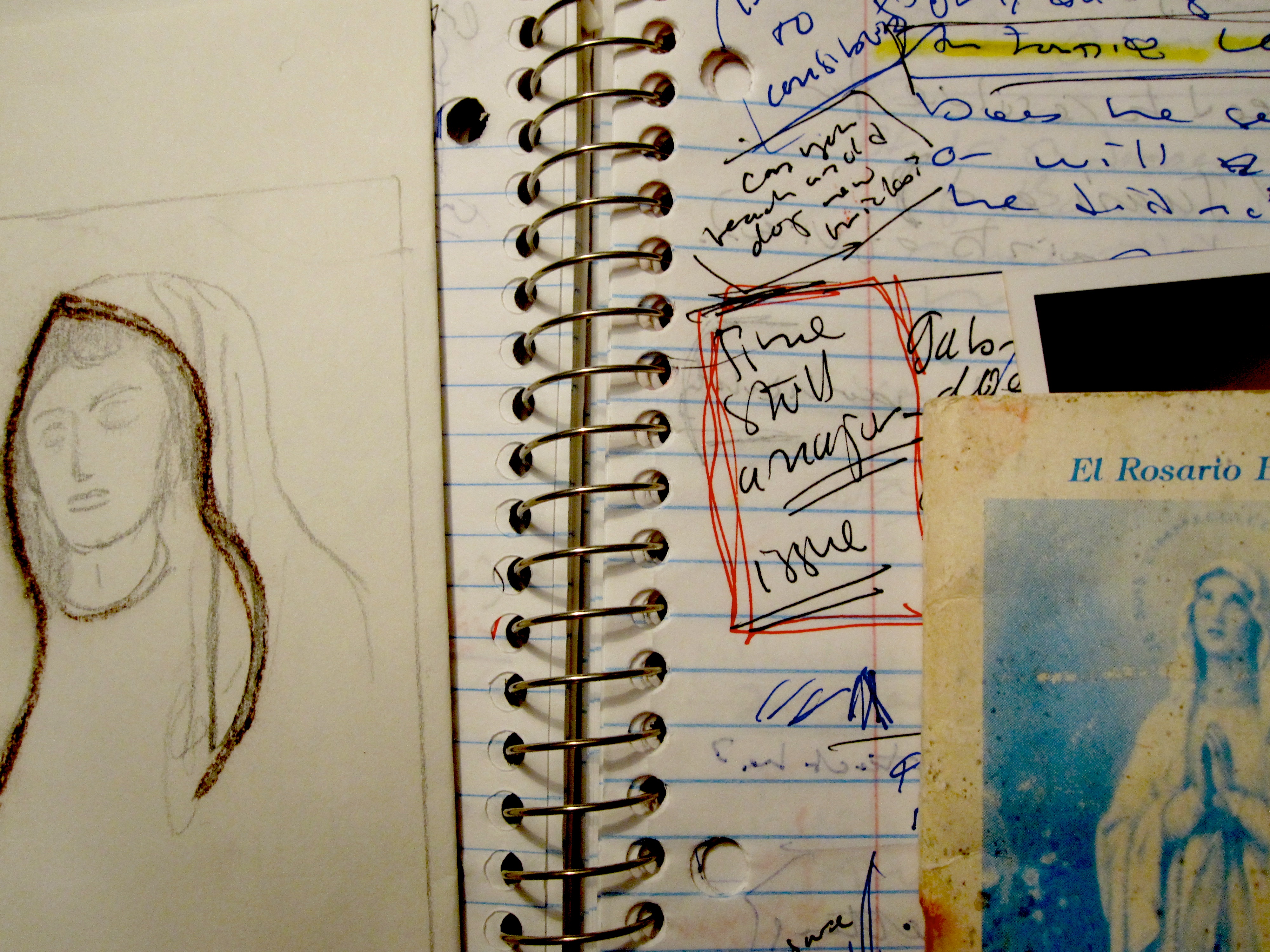
    I am fascinated by the notebooks of writers and artists–the doodles, bits of research and notes to self, the handwriting, the bad early drafts.  There is something necessary in the sheer chaos of a notebook or a box of clippings, scraps, and other ephemera. So much goes into the making of a book, a story, a single poem.

    A notebook I used while writing In the Place of Silence
    A notebook I used while writing The Good Sister

    Even my own notebooks and file boxes fascinate me. Sometimes I have no idea who that person was who wrote all those notes, clipped so many articles, drew so many pictures, used so many different colors of pens, cut up passages and taped them together in reverse order.  Writing envelops you when you’re in the midst of it, seals you right up with it.  It can be useful to see, especially when embarking on a new project, that a good piece of writing often begins in a big mess with quite a lot of  bad writing involved.

    That’s also partly why I love looking at notebooks and early drafts of work by writers I admire.  While I was in Dublin a few Junes ago, I was lucky to see a William Butler Yeats exhibit at the National Library of Ireland (The Life and Works of William Butler Yeats), where a lot of early, handwritten drafts of his poems were shown. Wonky handwriting, strikethroughs, botched titles: it was comforting to know that even the greatest of writers can sometimes begin a little off, or take wrong turns.  Yeats’s “Crazy Jane” was earlier named “Cracked Mary.” Cracked Mary had made it as far as a typed draft of the poem, but Jane hovers, handwritten, in the margins, then takes over to finally become its title, “Crazy Jane and the Bishop.”

    Every piece of writing you see in print–final, published–looks clean and simple, every word in its place. But its history is likely chaotic, beginning in a kind of Pandora’s box, in the disjointed form of clippings, photographs, diary entries, diagrams, and notes, all clamoring at the lid, wanting to discover what it all means.

    And even when the writing is published, perhaps it is never perfect. At a Colum McCann reading for Let the Great World Spin, he stopped in the middle of a paragraph, read it again, reread it, and then finally, chagrined, he looked out over his audience and asked if that sentence made any sense. “No,” he answered for us. “No, it doesn’t.” That sentence had managed to hold onto its chaotic beginnings, giving us readers a glimpse inside that box.

  • Imposter Syndrome

    When Storyfort, the literary component of Treefort Music Festival, offered to host me, and then put me on the main stage with the amazing Lidia Yuknavitch, I freaked out. I might’ve even jumped out of my chair and laughed out loud. I just had to tell someone. Right away. The first to be blindsided with the news was a co-worker of mine, just because he sat nearest to me.

    “Who’s that? What’s Storyfort?” He shrugged uncomfortably. “I don’t know what any of that is.” He turned back to his computer.

    If I was disappointed by his response, it didn’t register. I was too excited. I couldn’t believe that of all people, I would get to read with the writer I most admired in the festival lineup. Lidia Yuknavitch. Man.

    By the next day, my excitement made way for another feeling—unease. A voice in my head kept asking me: Who did I think I was, anyway? Who the hell am I to be sharing a stage with Lidia Yuknavitch? I answered with: I’m a writer, that’s who. I’m worthy. Surely I’m worthy. I am. Really.

    “Ah,” my friend Suzanne said over drinks that night. “A serious case of imposter syndrome.”

    But if there is any place to feel unworthy, to feel like an imposter, it’s in the room with Lidia Yuknavitch, a self-declared misfit. (Read The Misfit’s Manifesto and watch her TED talk. I know it made me feel a lot better.) Being a misfit—or someone who has “missed fitting in,” as she puts it—has been her entire life.

    And thank god she’s a misfit. She writes like no other—with raw, honest, brutal and loving intensity. Her writing might make us uncomfortable and it might kill us, but her memoir, The Chronology of Water, is one of those rare books that cuts straight to the heart of what it means to be a human being.

  • For what it’s worth

    Pickled letters_Istanbul
    Pickled letters at a graphic design studio in Istanbul.

    I’ve been quiet since the presidential election. Like many people, the election threw me—not because I didn’t think he could win, but because I couldn’t imagine it. Me, a fiction writer who speculates about nearly everything, playing out what ifs, the outcomes and meanings of various scenarios in my head, couldn’t imagine what the United States would look like with Trump as president. And after, I took it as a national and personal tragedy, thought I’d never feel happiness or hope again. As well as taking a close look at my country, I looked at myself, my life, my work. My fiction writing. And I wondered what it was worth.

    Several people told me: You’re a writer. You have the power to influence people and promote change. Use your skills. So I felt this pressure, this obligation to write essays that would move people to take some kind of action. I felt the importance of my fiction writing diminish in the face of such dire times. Unless I was writing something like 1984, writing fiction felt indulgent, frivolous.

    In an interview with Turkish novelist Elif Shafak on the New Yorker Radio Hour, David Remnick commented that it seemed like she was writing about politics in spite of herself—almost against her will. She replied that she doesn’t have the luxury to not be political, given the oppressive situation in Turkey and the fact that she’s Turkish.

    Writing at Ataturk Airport
    Writing at Istanbul Atatürk Airport

    I also felt like I was writing about politics against my will, and I also felt that same obligation as an American who believes in protecting—and fighting for—equality and civil liberties. To protect the ability to criticize, state opinions without repercussions, and yes—write whatever we want.

    And that’s key. When I spent some time in Istanbul last November, I learned from Turkish artists that one of the most rebellious things you can do to protest a political system bent on killing free expression is to keep doing your art. Thinking, writing, creating—are dangerous to the regime. When author and badass Naomi Klein was last in Seattle, she remarked that it was important to not just say no to the Trump agenda. We also need to “fiercely protect some space to dream and plan for a better world. This isn’t an indulgence. It’s an essential part of how we defeat Trumpism.”

    After writing essays, letters to representatives, and valentines to Washington State mosques, I began to incorporate fiction into my writing life again, cultivate it, let it take up more space. And it feels goods. Fiction’s my home. It’s the best way I can be a part of the world. Stories make us human, help us understand one another, provoke us to ask questions. Exercising this civil liberty is active protest. And it’s worth everything.

  • There Is Time

    At a recent reading at the Seattle Public Library, Colson Whitehead said of his new novel, The Underground Railroad: “I wrote this book when I was ready to write it. I wouldn’t have been able to fifteen years ago.” The idea came to him back then, but said he knew he wasn’t good enough to write the story.

    In a moment when I’m looking at the scraps and beginnings of a second novel, when I’m feeling the pressure of age and mortality, feeling in a hurry to get all these ideas out before I die, it’s good to keep in mind that there is time—and regardless, the work will come out when it’s damn well ready to. And you want it that way. Really.

    The two must converge: Your skill as a writer and it as an idea. I think of how it would be had I attempted to write The Good Sister in my twenties, when I’d just returned from Mexico and was living in a friend’s basement, trying to adapt to my new/old world while trying to make sense of the experience I’d had. It would’ve been a terrible book along the lines of my angsty journals, if it had been able to cohere at all.

    Sometimes I scold myself for not having worked harder on my writing in my twenties, that I should have worked through the post-college bewilderment via pounding out a book, putting my writing career in motion much earlier than at say, forty. But I know I couldn’t have completed my first novel sooner than I did. It needed all that time. It needed seventeen years.

    Had Whitehead gotten ahead of himself and tried to write The Underground Railroad when he got the idea, he said he would’ve screwed it up. So he shelved it, trusting there would be time. In between then and now (and now the novel is on the National Book Award longlist), he wrote other novels—got a little better, failed, had a relapse, got a little better…

    A moth flitted about in the light, eventually circling down to Whitehead as if to look him directly in the face. He laughed and gently brushed it away. “My spirit animal,” he said.

  • Vancouver: The Good Sister book launch

    Having spent a lot of time going to readings and talks, it was strange to be on the other side, looking out at the audience rather than being in the audience. As I stood there at Book Warehouse Main Street in Vancouver preparing to read, I remembered a couple of things heard and overheard in Seattle before I left for this event.

    Random guy in Cal Anderson Park, talking to his friends: “When you go in there, you’re nervous, right? So what I do is slowly scan the crowd…then they get nervous.”

    Poet Cedar Sigo, at the Sorrento Hotel for the APRIL festival: “A nervous breakdown and a good reading are closely related.”

    I didn’t put either of those things into practice that night (not intentionally, anyway), but any form of nervousness I might’ve felt was drowned out by a lot of love—from my parents and aunts who made it up to Vancouver from eastern Washington; from my friend Yukmila who flew out from Washington, D.C.; from UBC Creative Writing co-chairs Annabel Lyon and Linda Svendsen, as well as so many friends and allies who helped with the book; my agent, Dean Cooke, who flew all the way out from Toronto; from the lovely, gracious folks at Book Warehouse.

    There was also the incredible Minelle Mahtani, host of the 98.3 Roundhouse Radio show Sense of Place, which I was on the following morning. She surprised me during the interview with a clip she’d recorded of my dad talking about my writing.

    All came together to make a wonderful book launch, despite the rain clouds that gathered outside the door after a bright, sunny day. And the rain did eventually come. But it didn’t bother us. We made our own light.

  • All Is Fair…

    At the Hugo House Literary Series in April, novelist Andrew Sean Greer introduced the story he wrote for the prompt (“All is Fair in Love and War”): “I haven’t read this piece,” he said. “Not just aloud—but at all.”

    Earlier, my friend Erin Fried and I were talking about how some people can offer up what they write as soon as they write it. For National Poetry Month, friends of hers wrote a poem a day and posted every single one online. Erin was exasperated. “How can they do that?” she asked, meaning: Why can’t she? For so many of us, it takes a while to feel a piece is good enough to show others. That’s normal. But it made me wonder how much of that is perfection of craft, and how much is fear about how it will reflect us: If the piece isn’t good enough, then neither are we. I agonize over every bit of writing before I put it out there—even this blog post. But what if, just for a while, I didn’t?

    For one, it might be really fun. As Andrew Sean Greer read, he was as surprised and amused at elements of his story as the audience was. It was also revealing—Greer could only be himself, the act of writing exposed. Weird turns he took in his story and didn’t remember taking made for a kind of crash performance where anything could happen.

    It struck me as rather brave. When I mentioned this to him after the show, he said he could to do it because he’d just turned in a novel he’d been working on for years. It felt so good to work on something that wasn’t the novel, he said—it was like going out and having wild sex again. “Not that I know what that’s like,” he added. “I’ve been married for 20 years now.”

    I just completed my first novel, The Good Sister—it is at the printers’ as I write this—so I can understand a bit of what Greer is talking about. I do feel release as I begin embarking on a whole new project open to limitless possibility. However, I still find myself bound to shoulds—“marching orders,” as writers Ryan Boudinot and Aimee Bender call them. Some kind of boss in you says you should write about one thing, while your heart is aching to write about another. The boss’s voice is really loud; I end up succumbing too often.

    This time, though, I’m putting up a really good fight. The writing is really fun, and I aim to keep it so. The agonizing can—and will—come later.


  • Burn (or Bury, or Eat) This

    IMG_2646
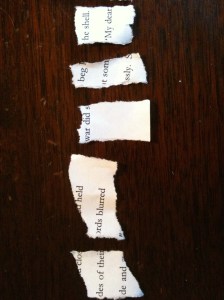
    Pieces of a torn up story. Later, I reconstructed it.

    When he was thirty, artist Richard Kehl said he burned everything he’d ever done. All his artwork—up in flames. Not only was it liberating to burn things, it was the only way to see with “beginner’s eyes”—and we must always see with beginners eyes, he said.

    As someone who saves just about every draft of everything she writes, this struck me with both horror and seductive intrigue. I wondered what would happen if I burned all my many boxes of papers—drafts of poems, stories and novels, and in some cases, the original works themselves. But I couldn’t imagine ever doing it. What if I lost something vital in there that would never return to me? But, too, what if these kept boxes were keeping me from moving into deeper, richer territory as a writer?

    In a KUOW interview, novelist Jonathan Evison talked about how he buried his first novel attempts. He wouldn’t disclose burial location or anything about these novels, only indicated that they were really bad and that they needed to be buried, rather than another method of destruction. He found the effect cathartic, clearing the way for his first published novel.

    Sandra Cisneros, when asked at a reading in Seattle what advice she’d give a beginning writer, said that one should write the truth, write all the things one doesn’t want to write or even think about, then tear the papers up into tiny little pieces—eat them, burn them, or let them float down the river.

    Tempting as that is, I find myself grateful for those writers who at least kept some of their raw drafts. To see their processes, mistakes, bad lines and titles is comforting. Even those considered our very best have often begun on shaky footing. I remember seeing an exhibition at the National Library in Dublin of W. B. Yeats’s early drafts of poems and feeling heartened by his struggles to find the right word or line. He began by failing.

    Early drafts are also works of art in their own right, with marginalia and strikethroughs and rewrites between the lines. I love seeing the draft destroyed with ink and reconstructed anew, constantly shape-shifting to find its true self. It’s enough to keep me creating, writing—and seeing with “beginner’s eyes.”

  • Old Growth Northwest Reading Series, Vol. VII

    10974322_922081331157635_4952943626972035777_o-194x300

    Tonight I’ll be taking a break from book editing and will be reading as part of Old Growth Northwest’s Reading and Open Mic series at the Rendezvous Jewelbox Theater in Seattle at 7pm.  I’ll be opening up for Doug Nufer (check out his self-interview in The Believer Logger) and Michelle Peñaloza (a fellow Poetry on the Busses poet).  Though the poster for the event is reminiscent of a boxing match, I won’t be fighting them.  At least, if they try to fight me I won’t fight back.  We’re just all going to get along instead.

  • In the Place of Silence wins the Prize for Best New Fiction!

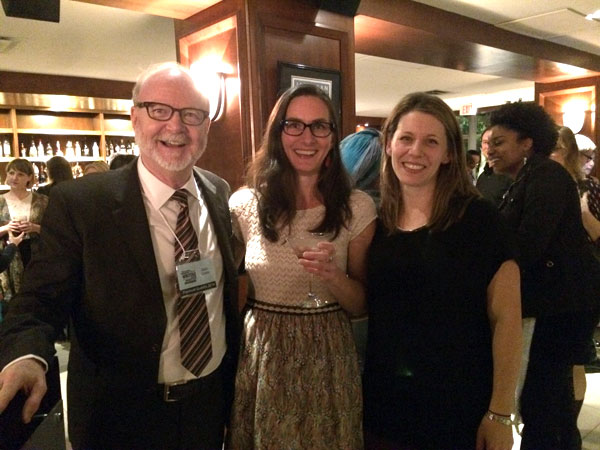
    Me with my agent, Dean Cooke, and the Editorial Director at HarperCollins at the prize announcement
    Left to right:  My agent, Dean Cooke, me, and Jennifer Lambert, the Editorial Director at HarperCollins, at the prize announcement on Granville Island. (Photo: UBC Creative Writing)

    At the Vancouver Writers Festival they shortened the shortlist and announced the winner of the UBC/HarperCollins Canada Prize for Best New Fiction. And guess what?   It’s me.

    This is an incredible honor. This means that not only do I have an agent, but I also have a book deal with HarperCollins Canada. The book is slated to come out in Spring 2016.

    I wrote this novel as my thesis for the MFA degree at the University of British Columbia seven years ago, and it’s amazing to me that it has finally found a home. There’s lots of work ahead—I have just begun digging into the editing process—but I’m excited for the chance to work on this book again, to make it the best it possibly can be.

    Below are the judges’ comments on the novel:

    Chelsea Bolan’s In the Place of Silence is a compelling and vibrant novel set in contemporary Mexico, where old paternalistic customs still hold sway. When a young girl is banished from her home, the reverberations are deeply felt in an already fractured family. Bolan portrays, with deft skill, a mother’s anguish, a sister’s desperate search and a father’s hypocrisy, alternating these distinctive narrative voices to build toward an ultimate revelation. Moving from the shiny resort towns of the coast to the most dangerous streets of Mexico City to the furtive, undocumented lives of illegal immigrants over the American border, In the Place of Silence is an engaging, beautifully realized novel, and a fascinating exploration of betrayal, steadfast devotion, and the ways in which our own biases can harm what—and who—we love the most.