Category: Process

  • To Return

    I.

    I’m sitting on the shores of Lake Washington, amazed at what I can do. I recently finished a solid draft of my second novel. Today I danced hard, biked to the beach, swam in the green-blue waves, and will later have to bike back up all those hills to home. But I can do it. My body and—miraculously—my mind are in the best shape of my life.

    Not bad for someone who’s come back from the dead.

    Coming back isn’t an accurate way to put it though. I died two years ago when I was diagnosed with an aggressive ovarian cancer. I was burnt down, ash of myself sifted through the hands of my doctors and nurses and those who cared about me. Now a new self is writing this—someone I don’t quite recognize, but who I love and want to get to know.

    II.

    I was diagnosed with clear cell carcinoma in May 2021, a few days after my second COVID-19 vaccination shot. After my surgery the next week, removing (along with all of my reproductive organs) a 14-centimeter tumor from my body, I spent a lot of time watching movies and trying to read as I convalesced. I noticed something I never noticed so much before—cancer is everywhere in books and movies. Sometimes it’s a main event, like in Big Fish, and other times it plays a cameo role or hovers in the shadows. But it is almost always there.

    I think fiction takes on cancer because it’s a nearly universal experience—everyone has either experienced it first-hand or knows someone who has experienced it. Giving a character cancer can make them change (or die), move or twist a plot. It can work as a believable deus ex machina in reverse, since anyone at all can suddenly have cancer, no matter how healthy, rich, or smart a person is. A very healthy person can get it (like myself) and it’s a toss-up whether they will get better (like myself) or die of it.

    Cancer is nearly universal—but when it happens to you, the journey you go on is yours alone. And it seems totally unbelievable—a case in which life is stranger than fiction.

    III.

    In my journals of that time, I described cancer as a failure of the body. But I don’t think it is. It seems more like an overexcitement of existence, so many cells dividing that they threaten the organs we need to live. Cancer is part of being a multi-cellular organism—it’s the risk of being alive. Perhaps the disease could be considered a type of creativity. The body births a strange beauty of extra cells, which collect into sculpture-like tumors. It creates its own blood supply to feed its dangerous art form. There is some kind of care taken to tend to the tumors, to assure their longevity and growth—while the rest of the body, the body that wants to live, wages war.
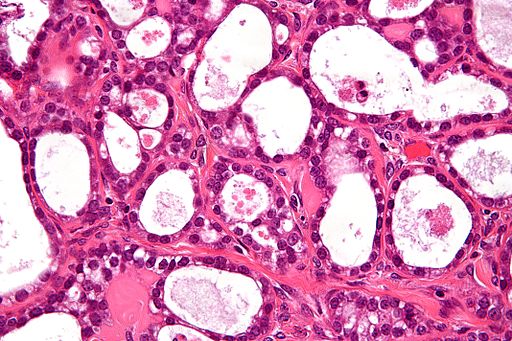
    Nephron, CC BY-SA 3.0 https://creativecommons.org/licenses/by-sa/3.0, via Wikimedia Commons

    Looking at images of clear cell ovarian cancer cells, I can appreciate their strangeness—even their beauty. Stained, they can look like marbleized paper, or abstract painting, or globs of dripped paint. Sometimes, they look like knitting, a shawl made not for wearing, for it won’t keep out the cold, but for its design alone—for the many open spaces.

    IV.

    Surgery first emptied me out, then chemo gutted and hollowed what was left. At my most empty, I had no idea if I’d return from this. And if I returned physically, would my mind?

    On a trip to Whidbey Island with my partner at the time, we met a friend of his I’d never met before—an acupuncturist who took one look at me and said, “That woman you were—she’s not here anymore.”

    V.

    I’m in a bikini on the beach, waves lapping my toes. The new moon stamps the sky. A thick scar begins at the delta of my stomach and curves around my belly button all the way down—a kind of seam where the dangerous sculpture was extracted. Where I was sewn back together, made into another art. It’s a single line painting by Miró. It contains a story, marks the point of no return. It’s the pain of a cracked egg and the beauty of birth. It’s what’s left of the woman I was, and from where I birthed a new self.
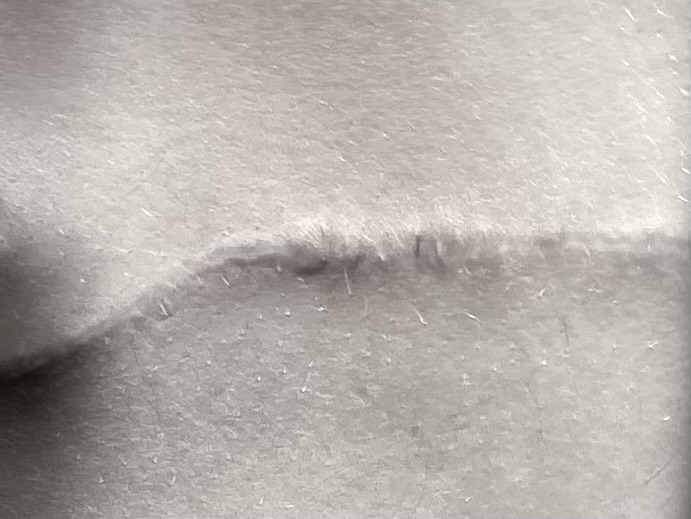
    My hysterectomy scar and Miró’s Painting on white background for the cell of a recluse (I), 20 May 1968, Fundació Joan Miró, Barcelona

    I’m no longer self-conscious of this scar, or feel it’s worth hiding from others. It’s etched on me the way Mt. Rainier is etched in the sky today, every glacier visible and clear.

    VI.

    The toxic medicines used to stop my over-exuberant cancer cells also seemed to stop the creativity in me for a time. It was the emptiest time. At least, that’s how I remember it.

    My friend and writing partner, Suzanne, came to see me every third week—which was my best week—after chemo. She came bearing sunlight, fattening snacks, her laptop and notebooks. We’d make a picnic and sit together out in my courtyard or at my dining room table, be in each other’s silence and presence, and write.

    The process of writing is blank in my mind. I know I worked on a story about the Soviet invasion of Prague, a moment that changed all of my characters’ lives irrevocably and forever. The tanks rolled in like rampant cancer cells, and nothing would ever be the same again.

    I felt like I was mimicking myself—the self I remembered from before. Before, I wrote. I was a writer. But who was I now? I was just typing, trying on a writer’s coat in the presence of another writer. I clacked on the keyboard, stringing letters into words, and words into sentences. So this is what a writer does, I thought. Clack, clack, clack. Clack.

    VII.

    I didn’t know, but I was stringing together a path to return. Like dropping stones to find your way out of a deep, dark wood.

    VIII.

    Later, after the big bad chemo was over and I was on my year of chemo-lite, I opened the file of my novel-in-progress to see if it would have any meaning for me now. My brain was still repairing from the damage the chemo caused and together with massive anxiety, I could only focus for a few minutes at a time, so it took me a while to get back into the material. When I did, I was surprised to find passages I didn’t recognize. I had, apparently, also worked on the novel in my sessions with Suzanne.

    I rediscovered that much of the book centers on the concept of identity, as the characters are guinea pigs for a Witness Protection Program so nascent it has no name yet. I found a note in the margins I’d written a few years ago: “If you get to live, but don’t get to be who you are—is being alive worth it?”

    IX.

    It was like I was writing to my future self, whoever that would be—like I had known what was going to happen to me. Somehow, I knew I would need this—that note, this novel about identity—to help me find a way to a self.

    While my characters were grappling with their multiple iterations of selfhood, I found my answer to that marginal question—a resounding fuck yes.

    X.

    Returning, I realized, isn’t about going back.

    It’s about picking up stones, one at a time, marveling at their shapes, their heft, their colors—their aliveness.


  • Focus, Focus

    We need to keep creating art. Especially in these hard times. Trust me on this. We need to be there for each other in all ways.  —Kelli Russell Agodon, via Twitter

    In a recent virtual literary happy hour presented by Hugo House, guest writer Marie-Helene Bertino mentioned that focus was a scarce commodity these days. “Collective grief really ruins attention spans.”

    That was the first time I realized that I might be grieving. I didn’t know I was grieving my old way of life, grieving for all the lives destroyed. And, as the weeks progressed, grieving for Black and Brown lives, grieving for all the harm this country has inflicted and continues to inflict, grieving for my own white ignorance and complicity—grieving for all the hundreds of thousands of dead.

    Joan Miró, Painting on white background for the cell of a recluse (I), 20 May 1968, Fundació Joan Miró, Barcelona, Spain.

    What I did know was that I was having trouble focusing on my own writing. It suddenly seemed so small and meaningless compared to the many life-and-death situations of others. In the early stages of the pandemic, I thought I would be able to make good progress on my next novel, but I found myself wondering why I was writing this and if it meant anything. The only thing I could focus on was food and scarcity. I checked my cupboards and inventoried my food stores so often the pulls on my cupboard doors fell off. But I couldn’t think much about my book. Then, as the death of George Floyd spurred protests and awareness around the world, I further wondered what my as-of-now sprawling book about identity and lost fathers mattered at all.

    What made things worse was that many people in my orbit seemed to be getting a lot of work done. Friends and artists I know were making art in response to the pandemic and the Seattle protests; others found solace in their writing—and all of this made me feel not only incredibly envious but also defective somehow. Why couldn’t I sink into my writing the way I’d always done?

    But I soon realized I was not alone. In R.O. Kwon’s opinion piece in the New York Times, she writes that the pandemic stopped her speaking gigs and travel so she finally had the time and space to work on her novel. “But,” she writes, “I couldn’t focus. What’s more, news aside, I could barely read. . . . I couldn’t recall why I’d even cared so much about books, words.”

    This was how I was feeling, and reading this helped me further acknowledge the grief. My perspective shifted. I needed to grieve. I learned too that I needed to take everything slowly. Allow myself the freedom to write any words or no words at all. To sit and do nothing, or draw instead. To cook meals and read what words I could. The first novel I could finally read beginning to end was The Fish Can Sing, by Icelandic writer Hallador Laxness, about a boy who aspired to sing. It was a soothing balm for the grief, and for finding my voice own again.

    I could think about art again. Extremely encouraging were tweets from poet Kelli Russell Agodon, reminders that art matters and we must continue to do our work. Someone needs it. We may not know who. We may not know why it matters. But it does.

    She writes:

    For those of you who are grieving—grieve on.

    Do not ignore this pain, it is a reminder of who we need to give power to and that we need to take care of each other. To stand up, to say—No, this should not happen.

    Be brave. Speak up. Make art.

    For some reason, I remembered sitting before Miró’s single line paintings at the Fundació Joan Miró in Barcelona just over a year ago—the Painting on a White Background for the Cell of a Recluse series. How I sat and absorbed a single line at a time, doing so because I didn’t understand them. I came to slowly see that a single line can be everything. Can have power. Can tell an entire story. Can be enough.

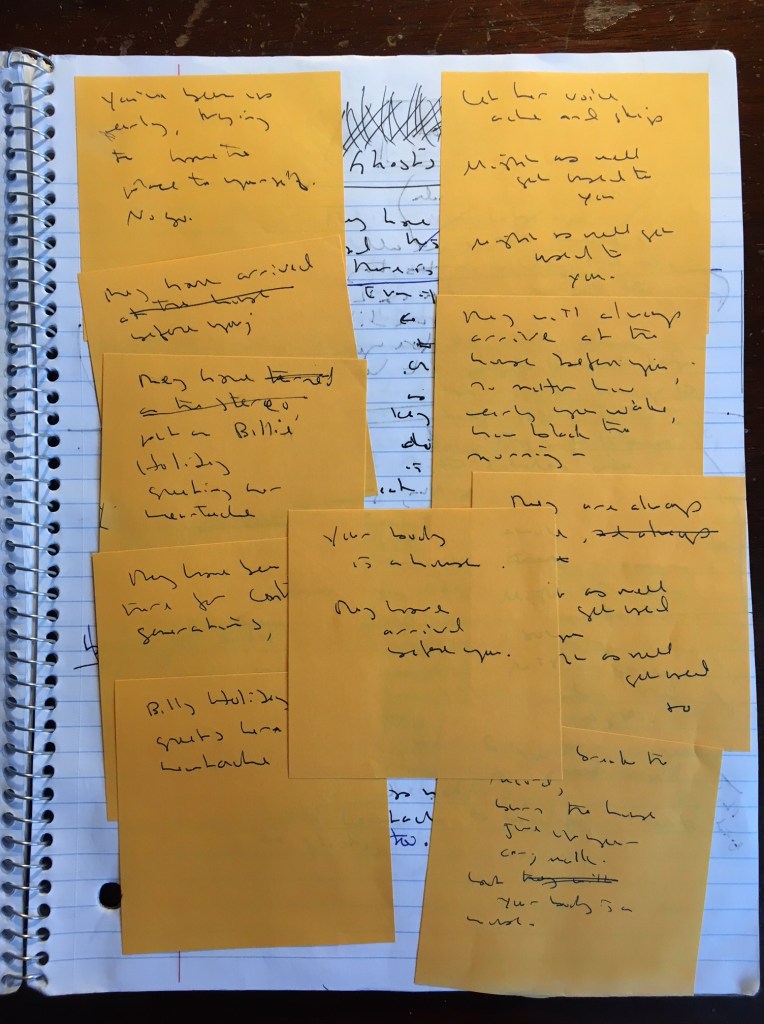
    I began to write words and phrases on sticky notes. These became lines, which I arranged and rearranged  in my notebook. I found I could focus on a single word, or a single line. These eventually became poems—poems, I realized, that centered on anxiety and grief. I just let the lines happen, good or bad, and in that way found myself slowly on the journey back to my book.

    Lines that eventually became the poem “Ghosts.”

    I’m not saying I can focus well. And I often don’t make my goal of editing or writing 500 words when I sit down to write. But I trust. I trust the work I’m doing. I may not know what it means or why it matters—all I know is that I need to write it. That is enough, and what it means, how it speaks to others, what it means to others will be revealed in the process. It will show me, if I let it, what it has to say.

  • Notes and scraps: building a piece of writing

    Notes and scraps: building a piece of writing

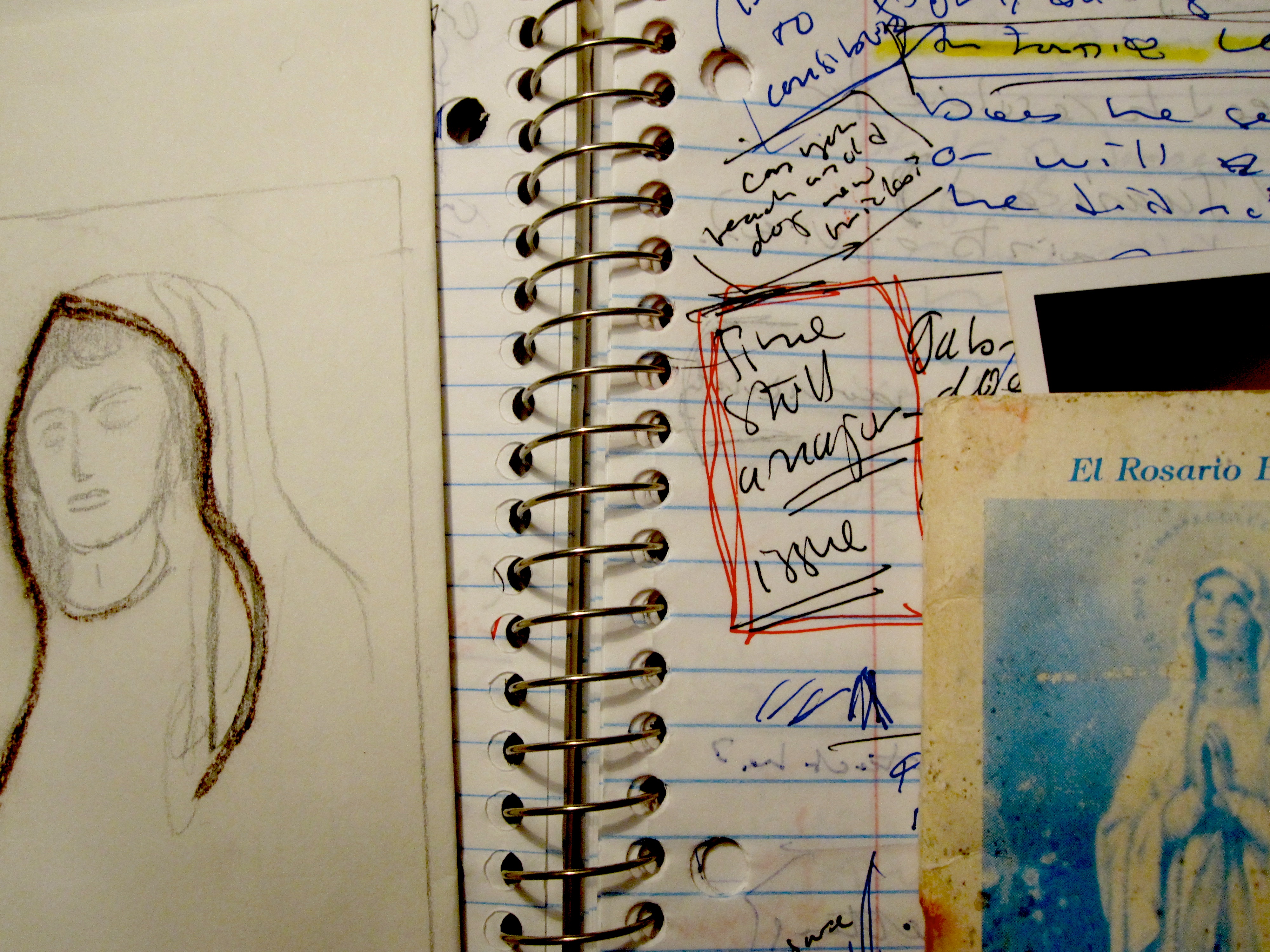
    I am fascinated by the notebooks of writers and artists–the doodles, bits of research and notes to self, the handwriting, the bad early drafts.  There is something necessary in the sheer chaos of a notebook or a box of clippings, scraps, and other ephemera. So much goes into the making of a book, a story, a single poem.

    A notebook I used while writing In the Place of Silence
    A notebook I used while writing The Good Sister

    Even my own notebooks and file boxes fascinate me. Sometimes I have no idea who that person was who wrote all those notes, clipped so many articles, drew so many pictures, used so many different colors of pens, cut up passages and taped them together in reverse order.  Writing envelops you when you’re in the midst of it, seals you right up with it.  It can be useful to see, especially when embarking on a new project, that a good piece of writing often begins in a big mess with quite a lot of  bad writing involved.

    That’s also partly why I love looking at notebooks and early drafts of work by writers I admire.  While I was in Dublin a few Junes ago, I was lucky to see a William Butler Yeats exhibit at the National Library of Ireland (The Life and Works of William Butler Yeats), where a lot of early, handwritten drafts of his poems were shown. Wonky handwriting, strikethroughs, botched titles: it was comforting to know that even the greatest of writers can sometimes begin a little off, or take wrong turns.  Yeats’s “Crazy Jane” was earlier named “Cracked Mary.” Cracked Mary had made it as far as a typed draft of the poem, but Jane hovers, handwritten, in the margins, then takes over to finally become its title, “Crazy Jane and the Bishop.”

    Every piece of writing you see in print–final, published–looks clean and simple, every word in its place. But its history is likely chaotic, beginning in a kind of Pandora’s box, in the disjointed form of clippings, photographs, diary entries, diagrams, and notes, all clamoring at the lid, wanting to discover what it all means.

    And even when the writing is published, perhaps it is never perfect. At a Colum McCann reading for Let the Great World Spin, he stopped in the middle of a paragraph, read it again, reread it, and then finally, chagrined, he looked out over his audience and asked if that sentence made any sense. “No,” he answered for us. “No, it doesn’t.” That sentence had managed to hold onto its chaotic beginnings, giving us readers a glimpse inside that box.

  • There Is Time

    At a recent reading at the Seattle Public Library, Colson Whitehead said of his new novel, The Underground Railroad: “I wrote this book when I was ready to write it. I wouldn’t have been able to fifteen years ago.” The idea came to him back then, but said he knew he wasn’t good enough to write the story.

    In a moment when I’m looking at the scraps and beginnings of a second novel, when I’m feeling the pressure of age and mortality, feeling in a hurry to get all these ideas out before I die, it’s good to keep in mind that there is time—and regardless, the work will come out when it’s damn well ready to. And you want it that way. Really.

    The two must converge: Your skill as a writer and it as an idea. I think of how it would be had I attempted to write The Good Sister in my twenties, when I’d just returned from Mexico and was living in a friend’s basement, trying to adapt to my new/old world while trying to make sense of the experience I’d had. It would’ve been a terrible book along the lines of my angsty journals, if it had been able to cohere at all.

    Sometimes I scold myself for not having worked harder on my writing in my twenties, that I should have worked through the post-college bewilderment via pounding out a book, putting my writing career in motion much earlier than at say, forty. But I know I couldn’t have completed my first novel sooner than I did. It needed all that time. It needed seventeen years.

    Had Whitehead gotten ahead of himself and tried to write The Underground Railroad when he got the idea, he said he would’ve screwed it up. So he shelved it, trusting there would be time. In between then and now (and now the novel is on the National Book Award longlist), he wrote other novels—got a little better, failed, had a relapse, got a little better…

    A moth flitted about in the light, eventually circling down to Whitehead as if to look him directly in the face. He laughed and gently brushed it away. “My spirit animal,” he said.

  • Burn (or Bury, or Eat) This

    IMG_2646
    Pieces of a torn up story. Later, I reconstructed it.

    When he was thirty, artist Richard Kehl said he burned everything he’d ever done. All his artwork—up in flames. Not only was it liberating to burn things, it was the only way to see with “beginner’s eyes”—and we must always see with beginners eyes, he said.

    As someone who saves just about every draft of everything she writes, this struck me with both horror and seductive intrigue. I wondered what would happen if I burned all my many boxes of papers—drafts of poems, stories and novels, and in some cases, the original works themselves. But I couldn’t imagine ever doing it. What if I lost something vital in there that would never return to me? But, too, what if these kept boxes were keeping me from moving into deeper, richer territory as a writer?

    In a KUOW interview, novelist Jonathan Evison talked about how he buried his first novel attempts. He wouldn’t disclose burial location or anything about these novels, only indicated that they were really bad and that they needed to be buried, rather than another method of destruction. He found the effect cathartic, clearing the way for his first published novel.

    Sandra Cisneros, when asked at a reading in Seattle what advice she’d give a beginning writer, said that one should write the truth, write all the things one doesn’t want to write or even think about, then tear the papers up into tiny little pieces—eat them, burn them, or let them float down the river.

    Tempting as that is, I find myself grateful for those writers who at least kept some of their raw drafts. To see their processes, mistakes, bad lines and titles is comforting. Even those considered our very best have often begun on shaky footing. I remember seeing an exhibition at the National Library in Dublin of W. B. Yeats’s early drafts of poems and feeling heartened by his struggles to find the right word or line. He began by failing.

    Early drafts are also works of art in their own right, with marginalia and strikethroughs and rewrites between the lines. I love seeing the draft destroyed with ink and reconstructed anew, constantly shape-shifting to find its true self. It’s enough to keep me creating, writing—and seeing with “beginner’s eyes.”

  • The Private Life of an Article

    Dan Smith and Claudio Sotolongo find a poster by Darwin Fornés in a shop in La Habana.
    Dan Smith and Claudio Sotolongo find a poster by Darwin Fornés in a shop in La Habana.

    I’d never really written an article before, and as I was writing what became “The Miracle of Saint Lazarus” in the Seattle Weekly, I found it a challenge to stick to the truth. What is the truth, anyway? We are constantly reinventing what we saw, what we heard, what really happened. Thankfully, I kept crazy notes and we recorded interviews and conversations, and my friend Daniel Ryan Smith took over 4,000 photographs—so usually there was something I could check my writing against. I was amazed how many things I did get wrong. I mixed up who said what, the colors of shirts and locations in Havana; a coconut shell became a baseball cap. It made me question all my memories, all the things I absorbed as truth, and made me wonder—did any of it really happen that way? Likely not.

    In an article, as in memory or in the many stories that make up our lives, events and details are arranged in a way that makes a better story, not necessarily how they happened in life. Some details are brought out while others are tossed into the ditch altogether, and moments and meetings with people that stretched out over days are strung into one narrative.

    But what I found most fascinating about writing a piece of non-fiction is that while the story seems to live in a frame, its tendrils are already extending out of that frame almost as soon as it’s written, seeking new soil, new stories. It’s a living, breathing being that has its own life.

    In the time between the publication of the article in mid-February and now, designer Idania del Río’s shop Clandestina finally opened; designer and tattoo artist Roberto Ramos opened a tattoo poster exhibition, and designer Darwin Fornés is moving forward with a new exhibition of posters for the Havana Biennale, a collaboration with designers from Seattle and from Havana, partially inspired by the Seattle Weekly article. This exhibition, he wrote in an email from Havana, will consist of cartoon characters from the US (which in the past were seen by the Cuban government as a dangerous ideological influence) and cartoon characters of Cuba. He said that “all of them together will look like a only one looong poster, like el malecon habanero.” They are working hard, he added, to get official permission to post the posters in some public spaces—which is a really big deal.

    So Cuban artists, too, keep pushing themselves and their art out of their frames. The story never ends—it only keeps expanding.

  • Writing in the presence of others

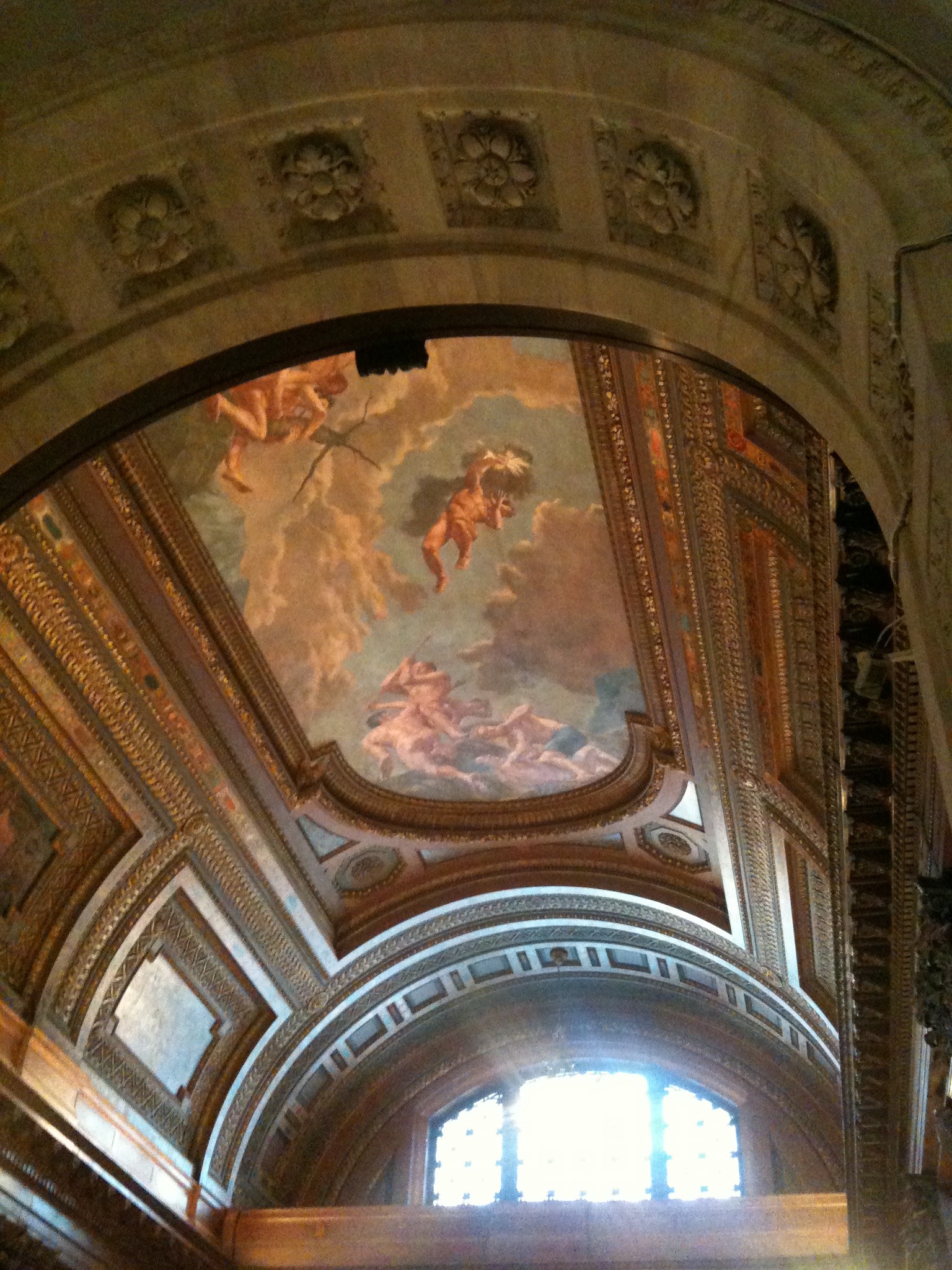
    The New York Public Library's Rotunda ceiling:  Prometheus bringing the gift of fire
    The New York Public Library’s Rotunda ceiling: Prometheus bringing us the gift of fire

    The New York Public Library, Rose Reading Room, place 423: This is where I sat and worked on pieces of my novel (and also to wait out the rainstorm) when I last visited the city.  I’m normally not very successful working in public places, and least of all in libraries, but there’s some kind of magic that happens at the Rose Reading Room.  Even though I’m surrounded by hundreds of people, I am able to sink in to my own work incredibly well. Maybe it’s the cathedral-like atmosphere, the commanding quiet.  The sounds heard in this room are functional:  Chairs scraping, someone sneezing, pages turning, the scratching of pens and pencils on paper.  Maybe I can sink in because everyone else is—whether reading, writing, studying, or researching, everyone is thinking in a concentrated way.

    The concentrated brain power changes the atmosphere, creates its own weather.  The energy of all of our thoughts collects above us, creating a greater energy than we could on our own.  Looking up, the paintings on the ceiling seem to verify this—the bruised clouds tinged with pink and gold are either gathering to storm or clearing to allow for more blue sky.  In our numbered places at communal tables, we are each a small Prometheus, bringing our bit of fire to the room—a silent offering.

  • The isolation factor

    Artist Jenifer Wofford once was given a large space to work in, but she shared that space with her students.  This meant anyone could come in at any time, see what she was doing.  Jenifer ended up liking doing her work in this atmosphere. “I have a tendency to be lazy,” she said, and having people drift in and out of the room kept her in check.  She said she got more work done than she did in a private studio.

    But more that this, she liked the buzz of the activity of people coming in at any time, unannounced.  She liked the discussions that arose around art, the commentary on works-in-progress—that perhaps this combination of elements made her work better than it could’ve been had she been given a private studio to work in.

    That made me wonder about the way I do my own work, and if my insistence on isolation is really always the way to work all the time.  What if I worked in a room with others?  How might that interaction with others, or simply the presence of others, affect my work?  Could others’ thoughts, their sounds, their breathing help shape a poem or a story or give sound to an idea? Would it become something I couldn’t have done in isolation?

    And finally:  Does writing have to be so lonely?

  • How we work v. how we think we should work

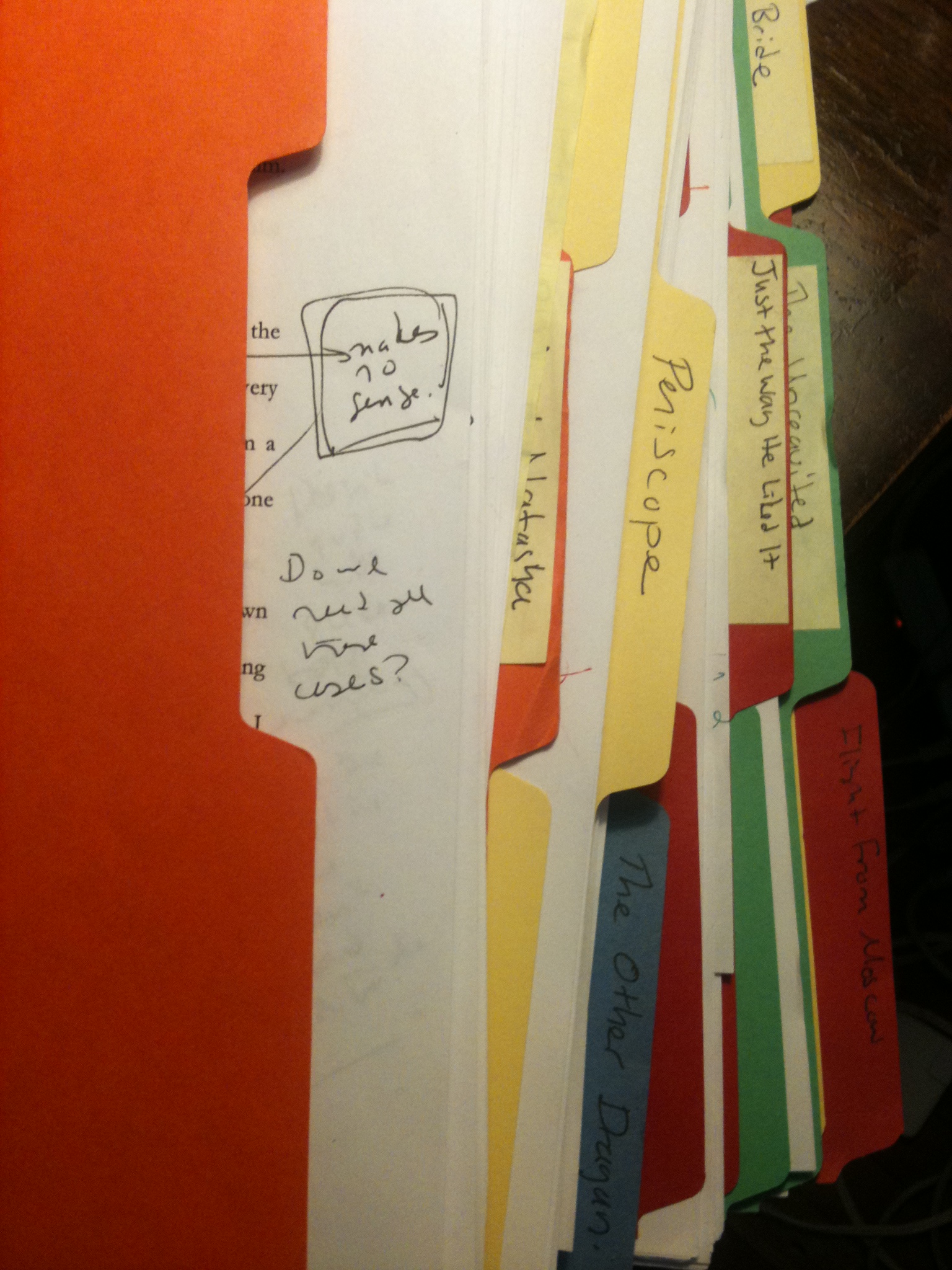
    Image
    Some of my abandoned stories.

    I usually give up on my work.  Most stories I’ve written, there comes a point where the story stumps me and I quit, abandon it.  I put all the drafts, notes, diagrams, and drawings into a folder, shut it and put it on the stack of other abandoned stories.  Then I move on, hoping the next story works out.  For a while, it does work out—writing seems to happen on its own, words know where to go.  The writing feels like reading—I’m writing to find out what happens next—which is my favorite place to be.  Inevitably, I hit that wall again.  And I look at the file folders of abandoned stories and feel a kind of panic.  I begin thinking like someone trying to save her sixth marriage (or so I imagine):  No matter what, I’m not leaving this story.  I don’t care how awful this story is, I will make it work.  And so with that in my head like a mantra, I hammer on, pounding the poor would-be story to death.

    The thing I forget in those moments is that I usually do go back to those abandoned stories.  I go back sometimes weeks later, and sometimes years later.  The character’s voice returns to my head, or I find out from either life or from another story what needs to happen, and I return. Sometimes I go back and leave them several times until the stories finally feel right, completed.  This doesn’t happen with every abandoned story—just ones that absolutely need to be told.

    This isn’t a failure.  It has taken me years to realize and accept that giving up on a story is the way that I work.  It has to happen that way, or else the stories wouldn’t happen at all.  The problem is that I’ve kept an image in my head of how writers should write—and therefore an ideal way of how I should work.

    I first met multi-media artist Jenifer Wofford in Prague when I was at that particular point of defeat.  I had returned from an Artist-in-Residence program in South Bohemia to research and finish a draft of a novel, and by the end of the residency, I felt like I’d failed at what I set out to do.  I had abandoned the novel, and though I’d moved on to work on other stories, I felt the weight of that failed novel in my gut—as well as literally in my bag.  Jenifer helped me drag the monster up all those flights of stairs to my room in the hotel where I was staying, and where she was working.  I apologized, as she took one end and I took the other, for the weight of research, books, paper drafts, and whatever else I thought I needed.

    A few weeks ago, I saw Jenifer again, as she came to Seattle to participate in an excellent group show, War Baby/Love Child, at the Wing Luke Museum.  Among many other things, we talked about how we work.  I saw myself in her process, how she tends to work on several pieces at once—that is, beginning one, then leaving it, beginning another.  She leaves behind a lot of open doors.  She said that sometimes when she stops working on a piece and is at work on another, she learns something about the piece she left.  Then she can go back to it—and the first piece becomes something that it wouldn’t have been had she not abandoned it first.  Her work informs her work, setting off a sort of conversation between pieces of art.  For this to happen, it’s essential that the doors be open.

    Now I think of my file folders as open doors, colorful doors that open into one another, whose inhabitants share secrets with each other—and occasionally with me.

  • How we arrive at the art we make

    My fiction teacher, Keith Maillard, told this story: When he was writing his novel Gloria, he would spend many hours lying on his bed in the middle of the afternoon, imagining his character Gloria’s bedroom.  In particular, he would imagine her closet hanger by hanger, shelf by shelf until he got it down to every single petticoat—until her closet became so real it wasn’t imagining anymore.  Then his wife came in and asked him what he was doing.

    “I’m writing,” he said.

    “No you’re not.  You’re sleeping.”

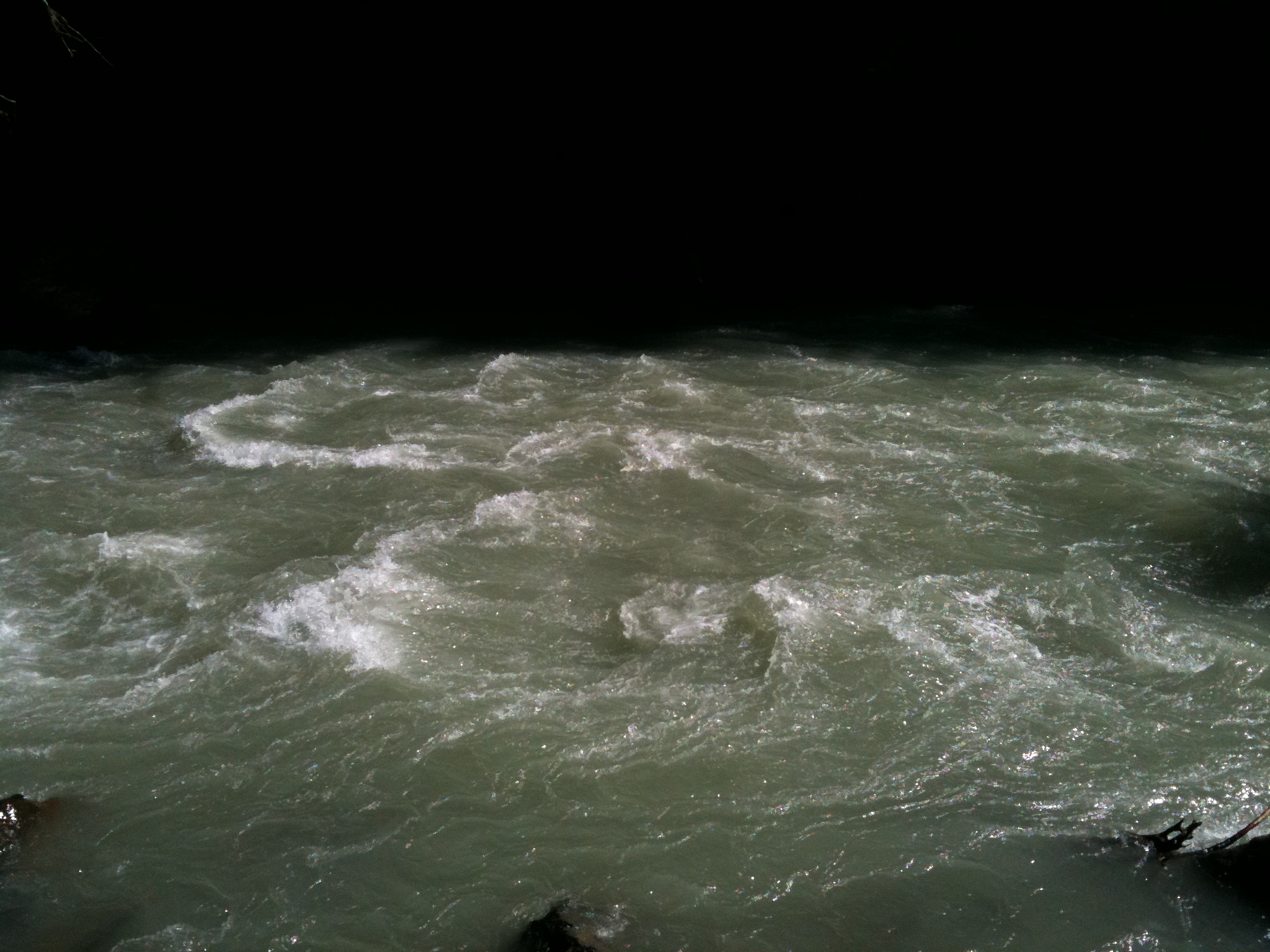
    So much goes into a piece of art, be it a novel or a painting or music, that is not the act of doing the thing that people think you should be doing.  In my high school Creative Writing class, my friend Adam often got scolded for not freewriting a million words in 10 minutes, and for doodling when he should be making words.  But do we need to always be making words if we are writers?  Perhaps we could do with a little veering from our form, imagining or doodling the world we wish to enter—or perhaps leaving it altogether to watch a river of milky glacial water pour over the rocks.

    IMG_2849